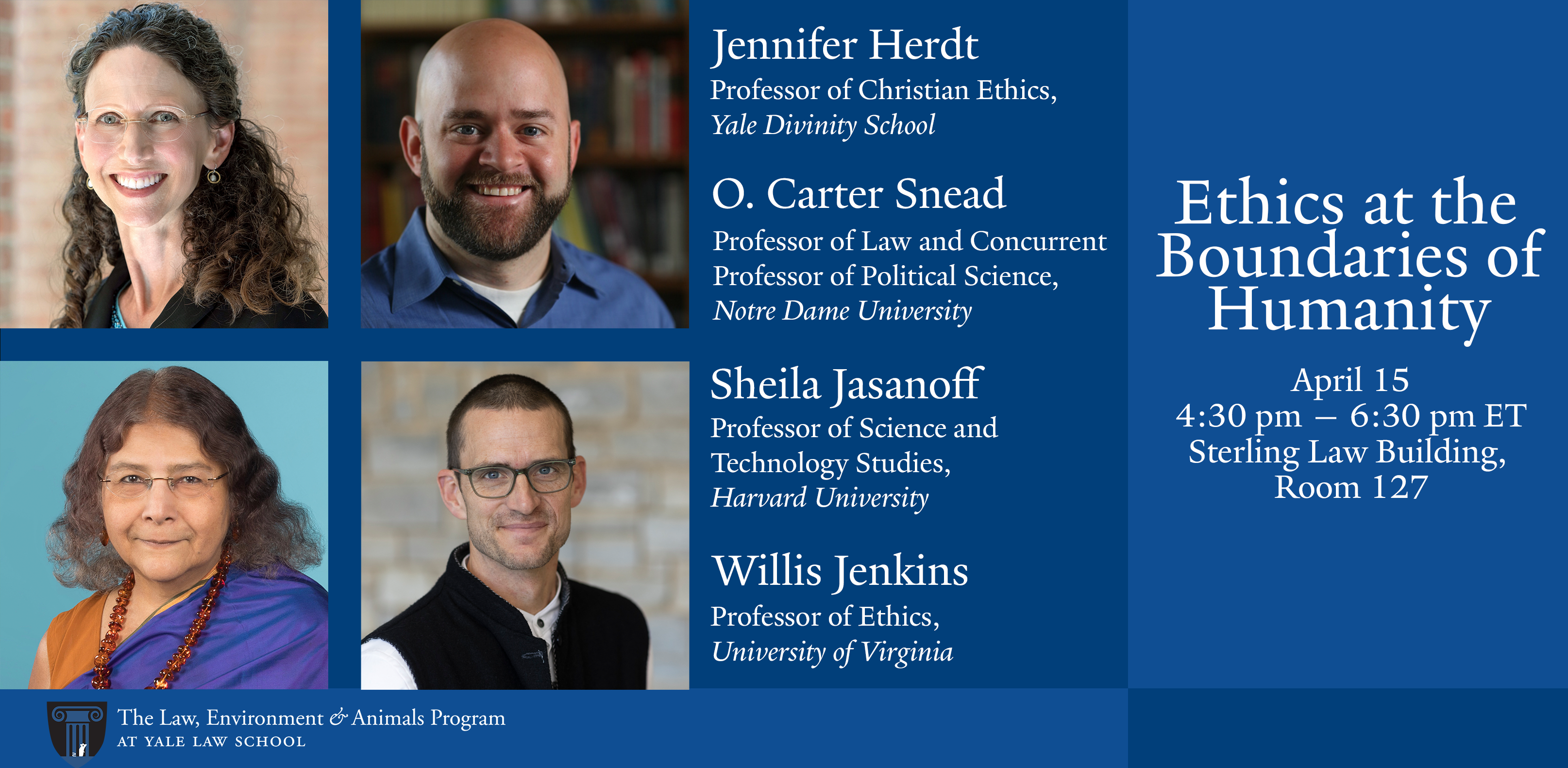
Who counts as human? What counts as humanity? Are there features of moral agency found in nonhuman animals? If so, how does that re-frame human moral agency? What duties do we owe to our fellow humans? What duties do we owe to those beings we consider nonhuman? Responses to questions such as these often have been predicated upon naturalistic conceptions of biology and an uncritical assumption that humans are exceptional.
In their forthcoming books, Jennifer Herdt (Gilbert L. Stark Professor of Christian Ethics and Senior Associate Dean of Faculty Affairs, Yale Divinity School) and O. Carter Snead (Charles E. Rice Professor of Law and Concurrent Professor of Political Science, Notre Dame University) explore the intersections of humanity, nature, biology, and technology, challenging our notion of what it means to be human and constructing new paradigms for understanding ethical obligations at the boundaries of humanity. In this panel discussion, Professor Herdt and Professor Snead will discuss their two books and will be joined by Sheila Jasanoff (Pforzheimer Professor of Science and Technology Studies, Harvard University) and Willis Jenkins (John Allen Hollingsworth Professor of Ethics, University of Virginia) for commentary and conversation.
Professor Jennifer Herdt’s "The Great Wheel of Being: Ethics Beyond the Human" questions the common invocation of Christian theology as a vision of human exceptionalism, in which humanity sits atop a Great Chain of Being near to God and superior to “lower” life forms. She draws instead on Pseudo-Dionysius’s image of a great wheel of being with God as the center and all forms of life existing in non-hierarchical relation. Professor Herdt reinvents the ancient practice of theoria physiké—the contemplation of nature—and explores dimensions of ethical agency we share with more-than-human beings, including empathy and care, cooperation, sensitivity to equity, recognition of social norms and roles, animal virtues, and play.
Professor O. Carter Snead’s "Ethics at the Edges of Humanity" explores how recent revolutionary innovations in bioengineering challenge already vexed questions regarding the ontological, moral, and ultimately legal boundaries of humanity. Using three case studies— “synthetic” human embryos, animal-human chimeras, and neural or cerebral organoids—Professor Snead explores the meaning of the human and our understanding of the markers of humanity, drawing upon the work of Hans Jonas to shed new light on what we owe to one another and what we owe to the world of living beings around us.
This event is part of the Law, Environment & Animals Program at Yale Law School's 2026 Speaker Series.
Speakers:
Jennifer A. Herdt is Gilbert L. Stark Professor of Christian Ethics at Yale University Divinity School and senior associate dean of faculty affairs. A past-president of the Society of Christian Ethics, from 2013-2021, she served as associate dean of academic affairs at Yale Divinity School from 2013 to 2021. She is the author of many articles and books on ethical formation, virtue ethics, moral agency, and responsibility, notably "Putting on Virtue: The Legacy of the Splendid Vices" (Chicago 2008) and "Assuming Responsibility: Ecstatic Eudaimonism and the Call to Live Well" (OUP 2022). Her forthcoming Yale University Press book is the fruit of a three-year collaborative grant in science-engaged theological anthropology funded by the Templeton Foundation.
O. Carter Snead is Charles E. Rice Professor of Law and Concurrent Professor of Political Science at the University of Notre Dame. His research explores issues relating to neuroethics, enhancement, human embryo research, assisted reproduction, abortion, and end-of-life decision-making. He is the author of "What It Means to be Human: The Case for the Body in Public Bioethics" and more than 70 journal articles, book chapters, and essays. From 2012 to 2024, he served as the director of the de Nicola Center for Ethics and Culture, building it into the most important center for interdisciplinary teaching, research, service, and public engagement in the Catholic tradition in higher academia.
Sheila Jasanoff is Pforzheimer Professor of Science and Technology Studies at the Harvard Kennedy School. A pioneer in her field, she has authored more than 150 articles and chapters and is author or editor of more than 15 books, including "The Fifth Branch," "Science at the Bar," "Designs on Nature," "The Ethics of Invention," and "Can Science Make Sense of Life?" Her work explores the role of science and technology in the law, politics, and policy of modern democracies. She founded and directs the STS Program at Harvard; previously, she was founding chair of the STS Department at Cornell. Her honors include, most recently, the 2022 Holberg Prize for her prolific academic efforts in the field of science and technology studies.
Willis Jenkins is Associate Dean for Arts & Humanities and John Allen Hollingsworth Professor of Ethics at the University of Virginia. He is the author of "Ecologies of Grace: Environmental Ethics and Christian Theology," which won a Templeton Award for Theological Promise, and "The Future of Ethics: Social Justice, Sustainability, and Religious Creativity," which won an American Academy of Religion Award for Excellence in the Study of Religion. He is co-editor of the "Routledge Handbook of Religion and Ecology" and many essays along intersections of religion, ethics, and environmental change.
Sponsoring Organization(s)
Part of the Law, Environment & Animals Program at Yale Law School's 2026 Speaker Series
Co-sponsored by Plant Forward Yalies, the Yale Animal Law Society, Yale Environmental Humanities, the Yale Interdisciplinary Center for Bioethics, and the Yale Sustainable Food Program